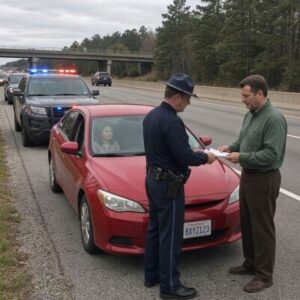
To the county in Indiana, she was still a nine-year-old who walked out of a courthouse and never came back. She was not hiding a crime. She was hiding from one, and she had been hiding so long she had stopped believing she was allowed to stop.
The fear in her eyes at that traffic stop was not guilt. It was a woman watching the one thing she had spent seventeen years outrunning finally catch up on an ordinary highway.
I drove back that night and did not go to a motel. I went to Vivienne’s house, and I sat on the porch, and when Adrienne came out I told her I knew, and she cried in a way I had never seen in fifteen years, because the person who knew had always been the person she feared most. It took her until dawn to tell me the whole of it.
Her father died in prison two years ago. The case was formally closed in the spring, not as a tragedy but as a survival, and her real name was restored to her records so that she is no longer, on any list anywhere, a child who is missing.
She uses her birth name on our new marriage certificate. We had it redone. She wanted to.
I spent fifteen years loving a woman I thought I fully knew, and it turned out I had never known the hardest, bravest thing about her, because she had been taught that being found would cost her everything. It cost her nothing. She was seen at last, on the side of a road, by a stranger and then by me, and instead of the danger she had braced for her whole life, what arrived was the simple, unbearable relief of no longer having to run.