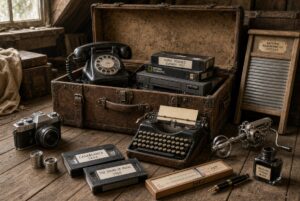
The old wooden trunk creaked open with a soft sigh of dust and forgotten years. Inside lay a strange collection that looked nothing like the sleek devices the children knew. A heavy black telephone with a circular dial full of holes sat beside a stack of thick black rectangles labeled “Home Movies Summer 1987” and “Casablanca.” A metal machine with round keys and a sheet of paper still rolled into it waited next to a ridged board and a glass bottle of dark ink. The children stared, turned the objects over in their hands, and asked the same question again and again: “What are these things supposed to do?”
Their mother sat on the attic floor with them, just as puzzled at first. She remembered some of the items from her own childhood but struggled to explain their purpose in a way that made sense to kids raised on touchscreens and streaming. The rotary phone, she said, once connected people by spinning a dial with your finger. The black rectangles were movies you had to rewind with a clunky machine. The typewriter made words appear on paper one loud click at a time. Still, the explanations felt incomplete. The objects held a quiet mystery, as if they belonged to a slower, heavier world that no longer existed.
They carried everything downstairs and laid the treasures across the kitchen table under brighter light. One by one the pieces began to reveal their stories. The film canisters once held photographs that had to be developed in a dark room. The slide rule helped people calculate before calculators existed. The washboard and hand-cranked egg beater spoke of work done by pure muscle and patience. Each discovery felt like opening a small window into the life their late grandmother had lived—days of waiting for letters, of recording family moments on tape, of writing letters that took days to arrive.
As evening settled in, the confusion slowly turned into something warmer. The children asked more questions, not just about how the objects worked, but about the woman who had kept them. Their mother told stories of summer visits, of the smell of ink and paper, of evenings spent watching the same home movies over and over. The strange items stopped being puzzles and became bridges. Holding the heavy phone or turning the typewriter’s platen, the children could almost feel their grandmother’s hands on the same surfaces years earlier.
By the time the trunk was closed again, the attic no longer felt like a place of lost and confusing things. It felt like a room full of quiet proof that life had once moved at a different pace, and that love could be stored in objects long after the person who used them was gone. The children still did not fully understand every purpose, but they understood enough. Some mysteries, they decided, were better kept a little soft around the edges, the way memory itself often is.